

Revenue where the enthusiasm is
How to design a café shelf that actually sells
There’s a simple truth about retail shelves in cafés: many of them don’t work particularly well. Not necessarily because the products are poor – but because they have little to do with the actual café experience. They just stand there, looking pretty, waiting for someone to pick something up by chance.
Yet a café has one crucial advantage over a traditional shop: the customer has often already experienced the product before they even stand in front of the shelf.
They’ve just had a really good coffee. Ordered a chai they’d never tried before. Tried the chocolate with their espresso. Drunk it from a cup they like.
That’s exactly where retail potential lies.
In short: a well-stocked café shelf extends the café’s own menu. Rather than offering as many products as possible, it’s worth having a small, coherent selection of items that the café itself uses, knows and can recommend. As a starting point, around five to eight products, different price points and a few seasonal changes make much more sense than a large, haphazard range.
Why do guests buy products in a café in the first place?
Café retail differs fundamentally from traditional retail. People don’t usually come to a café because they want to buy a bottle of chai, a bar of chocolate or a ceramic mug.
They come for the café itself.
Retail therefore often stems from an existing experience: the guest rediscovers something they enjoyed – whether it was a flavour or an atmosphere – as a product.
The strongest sales moment for the retail shelf does not, therefore, begin at the shelf. It begins on the menu.
From this, a simple rule can be derived:
The Cup-to-Shelf Principle
The more closely a retail product is linked to what a guest has just experienced in the café, the less the shelf needs to explain.
Or, to put it even more simply:
Taste → Recognition → Take-home
Try. Recognise. Take home.
This doesn’t just apply to drinks. The coffee from the flat white can be on the shelf as beans. The chocolate served with the espresso as a bar. The granola from breakfast as a packet. The chai from the cup as a bottle. The crockery used to serve it as a mug for at home.
A good retail range therefore doesn’t start with the question:
What else could we sell?
But with:
What do our guests already love?
What belongs on a retail shelf in a café?
The short answer: products that the café itself uses, is familiar with or has deliberately selected.
This is because the café takes on a different role to that of an ordinary retailer. It curates.
If a customer asks why exactly this particular chocolate, tea or chai is on the shelf, there should be a better answer than: ‘We found it at the wholesaler.’
‘That’s the chai you’ve just been drinking,’ on the other hand, is a pretty good explanation of the product.
The following categories are particularly well-suited to speciality cafés:
Coffee and tea
Beans from the café’s own roastery or the roastery it works with, speciality tea, matcha, hojicha or other teas that also feature on the drinks menu.
Here, the connection is particularly straightforward: the customer is already familiar with the product from their order.
Beverage bases and concentrates
Chai, cold brew concentrates or other drink bases are particularly well-suited to retail if they allow guests to easily recreate at home the drink they’ve discovered in the café.
In this case, the shelf isn’t just selling a bottle. It’s selling the chance to drink ‘my chai from my café’ at home.
Food items linked to the café’s own menu
Granola, chocolate, honey, spices, spreads or other products can be a good fit if they are actually used in the café or match its culinary signature.
A chocolate served with an espresso has a context.
Any old chocolate on the shelf is, at first, simply just a chocolate.
Ceramics and accessories with genuine practical value
Cups, glasses, filters or other accessories work particularly well if guests recognise them from the café or if there’s a story behind them – such as a collaboration with a local pottery workshop.
Merchandise for the sake of merchandise, on the other hand, needs a fairly strong brand to work on its own.
How many products should a café stock on its shelves?
More choice doesn’t automatically mean more turnover.
For a small or medium-sized café, we’d recommend starting with five to eight well-chosen product lines rather than jumping straight into twenty or thirty items.
This isn’t a universal sales formula, but a practical recommendation: a small selection is easier to explain, present neatly, reorder and monitor.
It also makes it clear why these particular products are on the shelves.
A simple starter range might look something like this, for example:
|
Product |
Price range |
Position on the shelf |
|
Small chocolate or snack |
under €10 |
impulse buy |
|
Speciality tea / small luxury item |
under €10–12 |
Entry-level |
|
House Coffee |
approx. €10–20 |
Well-known core product |
|
Chai retail bottle |
approx. €12–17 |
Drinks menu for home |
|
Seasonal product |
approx. €10–20 |
Rotation and occasion |
|
Ceramic mug / tasting set |
from approx. 25 € |
Gift / Premium |
The exact selection naturally depends on the café. A bakery with its own production facilities needs a different display to an espresso bar or a matcha café.
However, the principle remains the same: every product should have a reason for being there.
What price ranges are suitable for café retail?
Rather than stocking the entire shelf in a single price range, it makes sense to cater for different purchasing occasions.
A simple structure involves working with three tiers:
Under €10: small items where the decision to buy is low-threshold – for example, chocolate, spices or smaller tea products.
Around €10 to €20: products for guests who specifically want to take something home from the café – coffee, chai, tea, granola or other specialities.
From around €25: ceramics, tasting sets, larger packs or products that are more likely to be bought as gifts or as a deliberate purchase.
It is not possible to give a blanket answer as to which price bracket actually generates the highest turnover for every café. Location, customer profile, average spend and the café’s concept all play a significant role.
That is why the more sensible question is not: Which price range generally sells best?
But rather:
Which price point works for our customers?
This can be answered quite objectively after a few weeks by looking at sales figures.
How should a retail shelf in a café be arranged?
Even a perfectly chosen product won’t sell well if nobody understands why it’s there.
That’s why a café shelf shouldn’t look like a small warehouse.
1. Show the connection with the menu
The most effective message is often also the simplest:
“Our House Chai – perfect for at home too.”
“The beans from your flat white.”
“Our breakfast granola.”
This is far more relevant to guests than a long manufacturer’s description.
2. Prices must be immediately clear
If a guest has to ask what something costs, it creates unnecessary friction. Small takeaway purchases in particular should be straightforward without the need for advice.
3. Group by use, not necessarily by manufacturer
Coffee + filter + cup can make more sense than three separate brand sections.
The shelf should tell little stories.
4. Give bestsellers the prime spot
Products that guests already recognise from the menu do not belong in the bottom corner. Visibility at eye level or in the immediate vicinity of the ordering or collection area makes the connection easier to recognise.
5. Less stock, more context
Twelve identical bottles side by side may create the impression of abundance, but they tell no story.
A single bottle, a matching cup and a small note about the drink can be more meaningful than a whole layer of cartons.
The stock should stay in the storeroom.
How often should a café change its retail range?
A well-stocked shelf doesn’t need to be completely revamped every week.
Two or three deliberate seasonal adjustments a year may be enough to tailor the range to the drinks menu and the actual needs of the customers.
In spring and summer, for example, cold brew products, iced drink bases, lighter teas or summery ceramics can be given greater prominence.
Autumn and winter are ideal for chai, stronger coffees, chocolate, spices and gift items.
The key point here is: do not replace the entire stock.
The products for which the café is already well-known form the core. Seasonal products simply alter the presentation around them.
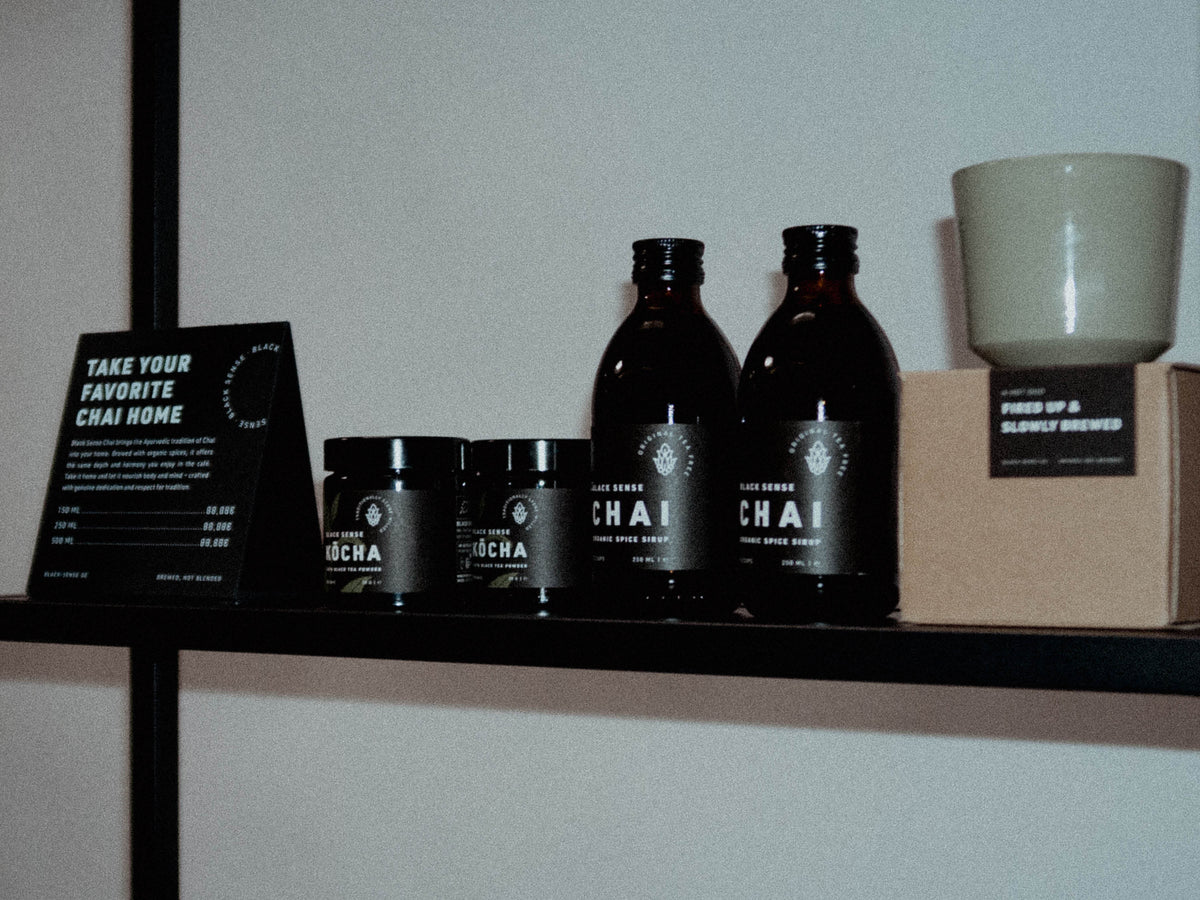
Example: A ‘Warming Drinks’ corner in autumn
Let’s take Black Sense Chai as a specific example.
A café features chai latte on its menu and uses Black Sense for it. In autumn, a small display is set up next to the retail shelf:
- the chai bottle for home use,
- a matching ceramic mug,
- a small spice or baking product.
Next to it, you won’t find the full history of Black Sense.
But perhaps simply:
‘The chai from your mug – for at home.’
Suddenly, there aren’t just three random products there.
Together, they create a whole experience.
That’s the difference between a bottle of syrup on the shelf and the feeling of taking a little piece of the café home with you.
How do you find out what actually sells in your own café?
This is where retail gets more interesting – because instead of changing the range every few months based on a hunch, you can test it very easily.
For each product, four pieces of information are enough to start with:
Purchase price – retail price – number of items sold – time period.
It’s also worth noting whether the product is featured on the menu and where it’s positioned in the café.
After eight to twelve weeks, it becomes clear:
Which products are selling well?
Which ones are stagnating?
Which products sell well seasonally?
And above all: do products that guests recognise from the menu actually sell better than purely retail products?
In this way, the shelf layout evolves from the café itself, rather than being organised according to general retail rules.
Why is retail worthwhile for cafés in the first place?
Additional turnover from existing customers
The café doesn’t necessarily have to create extra seating or produce more drinks at the same time to generate this revenue. It capitalises on a moment that arises naturally anyway: a customer is already there and is enthusiastic about something.
Curation becomes part of the café’s identity
A well-curated shelf showcases the producers, roasters and manufacturers a café works with.
This makes the sourcing process visible.
Particularly in the speciality coffee sector, this can form part of the café’s own positioning.
The café experience follows you home
A packet of coffee on the kitchen table, a bottle of chai in the fridge or your favourite mug from the café all have one side effect: the café stays with you even after your visit.
Not as an advert.
But as a product that’s actually used.
Where can cafés find suitable retail products?
The simplest place to start is surprisingly unspectacular:
Ask the manufacturers you already work with.
Many producers in the speciality coffee and café sector offer retail sizes or B2B terms for resale alongside catering packs.
If you serve a particular coffee, ask the roastery for retail bags.
If you serve chocolate with your espresso, ask for bars to sell.
If you have chai on your menu, ask for the retail bottle.
If you’re looking to discover new producers, you can also use curated B2B marketplaces such as Faire. Smaller minimum order quantities can be particularly useful for initial trials.
And then there’s another source that’s often overlooked: your own town.
Local pottery, small food producers, roasteries or manufacturers can give your shelves a distinctive character that you can’t order from a standard catering catalogue.
The most common mistakes in café retail
If we had to boil café retail down to a few typical problems, they would be these:
Too much choice. The shelf becomes a sales area with no discernible curation.
No link to the menu. Products must stand on their own merits.
No visible prices. A straightforward purchase turns into a request for information.
Too much manufacturer communication. Guests shouldn’t have to read a brand’s corporate history first to understand why the product is there.
Insufficient analysis. Products are replaced because they ‘don’t seem to be selling’, without comparing their placement, timing and sales figures.
Retail is treated as decoration. A beautiful shelf is good. A clear shelf is better.
A simple checklist for your café shelf
Before you put a product on the shelf, ask yourself five questions:
- Do our guests already recognise the product from our café?
- Can we explain in one sentence why we chose it?
- Is it immediately clear how much the product costs and how to use it?
- Does it complement the existing range, rather than simply adding to the choice?
- Will we check after a few weeks to see if it’s actually selling?
If you answer ‘no’ to several of these questions, the product is probably not yet a good candidate for your shelf.
Conclusion: Don’t start with the shelf. Start with your menu.
A good café retail concept doesn’t have to be huge or complicated.
First, look at what your guests are already ordering, recommending and asking for again. From these, choose a few products that make sense to take home. Add different price points and a few seasonal items. Make the link between the menu and the shelves clear. And then measure what actually works.
Generate revenue where the enthusiasm is.
The best place for additional retail revenue is often exactly where enthusiasm has already been generated.
Black Sense Chai for your café shelf
Do you already have Black Sense Chai on your menu, or would you like to trial it in your café first? Our retail bottles are available for resale in your café. This means the chai your guests discover at your café can be taken straight home.
No middlemen, no minimum order value – direct from Black Sense Manufaktur.


