

Glass is considered a natural, high-quality, and virtually infinitely recyclable packaging material. Nevertheless, glass is not automatically the most environmentally friendly packaging option. Its heavy weight, energy-intensive production, and long transport distances play a significant role in its actual environmental impact. For cafés and restaurants in particular, it’s therefore worth taking a closer look.
Why does glass have such a good reputation—and is it true?
Glass consists primarily of quartz sand, soda ash, and lime. It contains no plastic, is not a composite material, and is generally very easy to recycle. In addition, glass is flavor-neutral, reliably protects the contents, and conveys a sense of high product quality. These are real advantages, especially for products that are on display in a café or sold to end customers.
What’s often overlooked is that glass is heavy.
A standard 750-ml glass bottle can weigh several hundred grams even when empty. This extra weight is transported throughout the entire supply chain. For cafés and restaurants that regularly purchase large quantities of a product, this difference can add up significantly.
More packaging weight means more transportation effort—and thus potentially higher transportation-related CO₂ emissions.
How does glass recycling actually work?
One of the greatest advantages of glass is its recyclability.
In principle, glass can be melted down again and again without losing its essential material properties. In practice, however, the quality of the recycling process depends on how clean and uniformly sorted the waste glass is collected and processed. That is why container glass in Germany is collected separately by color:
- White glass
- Brown glass
- Green glass
Color separation is important because different glass colors cannot be easily separated from one another during the melting process. White glass, in particular, requires a very high degree of purity. Shards of other colors can compromise the quality of the new glass.
Why is glass of other colors included in the green glass bin?
Glass colors for which there is no separate container—such as blue glass—are usually sorted with green glass. Green glass can tolerate a higher proportion of other glass colors during recycling than white or brown glass. Therefore, to ensure that recycled glass can actually be reused to a high standard, it is not only crucial that the glass is recycled, but also how cleanly it is sorted and processed.
Which consumes more energy: new glass or recycled glass?
Recycled glass has a significant advantage over glass produced entirely from primary raw materials:
The use of glass cullet can reduce the energy requirements of glass production.
The higher the proportion of suitable recycled glass fragments—known as the cullet content—in the melting furnace, the fewer primary raw materials need to be used and melted. Thus, a high proportion of recycled glass generally improves the environmental footprint of glass packaging. However, the overall environmental impact of packaging is not determined solely by its production.
These factors also play a role:
- Weight of the packaging
- Transport distance
- Transport capacity utilization
- Recycling rate
- Actual recycling pathways
- Reusable or single-use
- Product cooling requirements
- Amount of packaging required per serving
Especially during transport, the high weight of glass can therefore be a disadvantage.
When is glass a sensible packaging choice?
Glass has clear strengths—especially where its material properties are actually needed.
This applies, for example, to products that:
- are displayed at the point of sale,
- are sold directly to end customers,
- are reused or refilled multiple times,
- are particularly aromatic,
- are sensitive to light,
- require a very high barrier effect.
Amber glass also offers increased light protection and can better shield light-sensitive contents from certain UV and visible light wavelengths.
For a retail bottle in a café, glass can therefore be a very practical packaging choice.
When might lighter packaging make more sense?
The situation is different for large containers used in the foodservice industry.
This type of packaging isn’t typically displayed decoratively on the counter. It’s stored in the warehouse, used behind the bar, and reordered regularly.
Here, other factors take precedence: How much product can be transported using as little packaging material as possible?
This is precisely where lightweight packaging systems like bag-in-box can offer advantages. A bag-in-box system typically consists of a flexible inner bag and a stabilizing cardboard box. Relative to the product it contains, the packaging is very lightweight. Especially for liquids, concentrates, and larger containers, this can significantly reduce the transport weight compared to multiple glass bottles.
Less packaging weight per liter of product can mean lower transportation emissions.
However, which packaging achieves the better overall environmental footprint always depends on the specific product, packaging system, transportation route, and life cycle.
Retail vs. Foodservice: Two Applications, Two Requirements
The question should therefore not be: “Is glass sustainable or not?”
It makes more sense to ask: “Which packaging fulfills its purpose in this context while using as few resources as possible?”
A retail bottle and a three-liter foodservice container serve completely different functions.
Retail
The packaging is visible. It is handled, taken home, and possibly reused. Product protection, feel, and presentation play an important role.
→ Here, glass can be very useful.
Foodservice
The primary purpose of the packaging is to efficiently transport larger quantities of product into the café and behind the bar.
→ In this context, lightweight bulk containers can offer advantages over individual glass bottles.
How does Black Sense make this decision?
This is precisely the distinction we make at Black Sense.
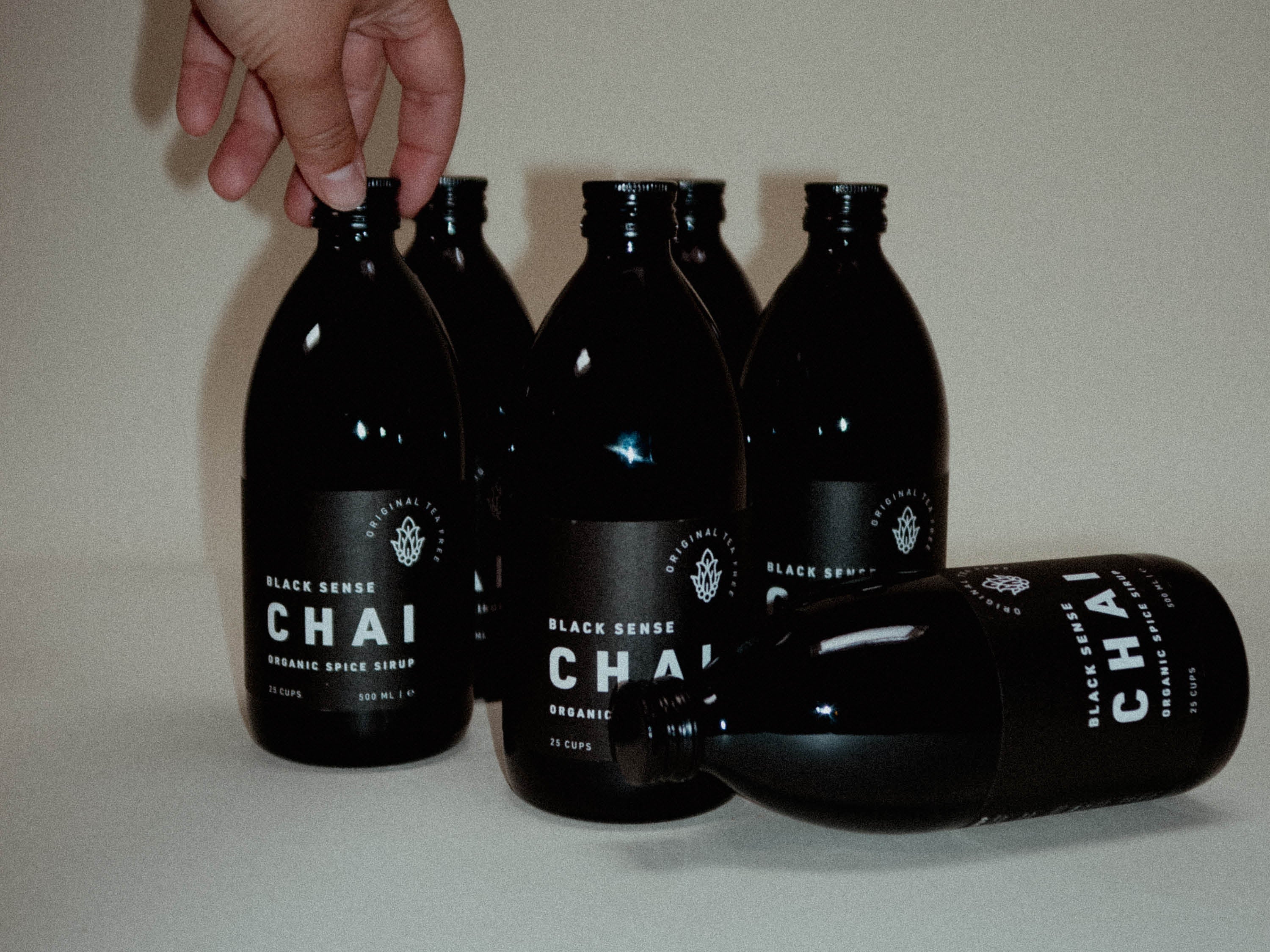
Amber glass for our retail bottles
Our smaller chai bottles are filled with amber glass.
They are prominently displayed in the café, can be sold directly to guests, and at the same time protect the contents from light. Here, glass fulfills several functions at once: product protection, presentation, and reusability—and when it’s no longer needed, it’s safely disposed of in the glass recycling bin.
Bag-in-Box for the Foodservice Industry
For larger foodservice deliveries, however, we rely on bag-in-box.
A three-liter bag of Black Sense Chai yields about 150 drinks at our recommended dosage. Instead of dividing the same amount of product among several heavy glass bottles, it is transported in a compact bulk container and used behind the bar. For us, this is not a worse alternative to glass.
It’s a conscious decision to use different types of packaging where their respective properties make the most sense.
And then comes the most important part: What happens after the café?
Even the best theoretical recyclability is of little use if packaging ends up in the wrong waste stream. In the foodservice industry in particular, high volume, limited space, time pressure, and diverse waste streams all come into play.& nbsp;That’s why it’s worth organizing packaging disposal just as carefully as purchasing it.
For glass, this means above all: Glass containers must be sorted by color and placed in the glass recycling bin—not in the general waste.
Because only when the material actually enters the intended recycling loop can theoretical recyclability turn into actual recycling.
FAQ: Glass, Recycling, and Packaging in the Food Service Industry
Is glass recycling reliable in Germany?
Germany has a well-developed infrastructure for the collection and processing of glass containers. Key factors for high-quality recycling include proper color separation and minimizing contamination. However, not every country has such a system in place, which is why some of our European partners face challenges with recycling.
Why can bag-in-box be environmentally sound for foodservice establishments?
The main advantage is the low packaging weight relative to the amount of product it contains. Especially with larger liquid containers, this means significantly less packaging material needs to be transported compared to multiple individual glass bottles. Whether the overall environmental impact is actually better, however, depends on factors such as manufacturing, transport distance, recycling, and product requirements. The key point is that the image here is significantly worse, and upon closer inspection, this discrepancy becomes apparent.
Can glass really be recycled indefinitely?
From a materials science perspective, glass can be repeatedly melted down and processed into new glass without losing its fundamental properties. In practice, however, a closed-loop system depends on whether the used glass can be properly collected, sorted, and processed to a sufficient standard of quality.
What type of packaging is recommended for organic products in the foodservice industry?
There is no single “best” type of packaging. Key factors include product protection, packaging weight, transportation route, container size, refrigeration requirements, reusability, and recycling options. For products displayed on store shelves, glass can be an excellent solution. For bulk containers used in day-to-day foodservice operations, however, lighter packaging systems can offer significant practical and environmental advantages.
Conclusion: Glass is not automatically sustainable – but it’s not automatically the wrong choice either.
The sustainability of packaging cannot be determined by the material alone.
Glass scores high in recyclability, product protection, and reusability. At the same time, it is heavy and requires high temperatures during manufacturing and recycling.
Lighter packaging saves on material and transport weight but presents other challenges in manufacturing and recycling. The most sensible packaging strategy may therefore be to avoid using a single material for everything. At Black Sense, this means: amber glass where glass offers real added value. Bag-in-box where weight, volume, and efficient handling are more critical.
It’s not the packaging with the best image that wins—but the one that makes the most sense for its specific application.


